
The short answer: you built your team for all the right reasons. The cost savings, the speed advantage, and keeping the brand close makes sense. But something doesn’t add up. Your team is busier than ever, but the writing doesn’t improve. Here’s why — and what to do about it.
Every Project Your Team Delivers Has Two Potential Returns. Are You Capturing Both?
Think about the last project your in-house team completed. The campaign went out, the content went live, the assets got delivered.
But did your writers get better? Will the next project reflect increased skill?
Because that’s your second return — a team that is measurably more capable at the end of every project than it was at the start. It’s the return that compounds over time and turns a good writing team into a great one, and a continually improving (and more motivated) one. It’s the return most in-house teams aren’t capturing.
Why? Because there’s no time and/or no development plan. And, it’s more and more common as writers become more dependent on AI tools. Which brings me back to…
Why You Built an In-House Team in the First Place
The shift to in-house teams isn’t a blip. It’s the direction marketing is taking.
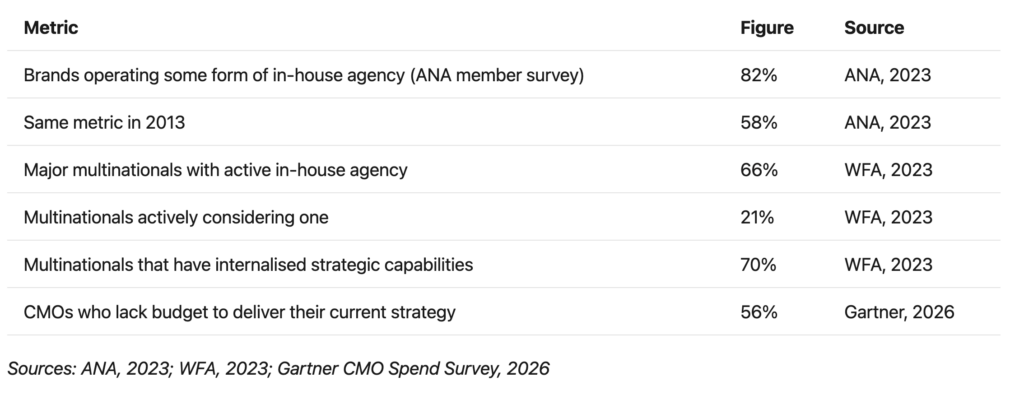
And companies that have built in-house teams are seeing real results. Maverick Studios, the internal agency for Inspire Brands, delivers campaigns 70% faster and at up to 81% lower cost than external agencies — and took home IHAF’s In-House Agency of the Year for 2025 (IHAF, 2025). Brooks Running’s Creative Lab, which became the brand’s agency of record in 2022, recorded North American lifts of 4.1% in brand awareness and 6.1% in purchase intent (IHAF, 2025).
That’s solid evidence for building a team. The model works. The question is whether it’s working as well as it could — and whether the three things you built it for are actually being delivered.
Control, Speed, and Cost. Are Those Promises Holding Up?
Most in-house teams are built on three promises: tighter brand control, faster turnaround, and lower costs.
The reality is this: All three of those promises have the same ceiling — the capability of your writers. And right now, for reasons I’ll look at in a moment, that ceiling is probably not rising, and it’s a common bottleneck.
The 2025 IHALC Benchmarking Report asked in-house leaders to name their top priority for the next twelve months. 67% said raising creative standards (IHALC, 2025). Not faster output. Not lower costs. The quality of the work itself.
Why Is the Writing Not Getting Better?
There’s brand control problem
Brand control doesn’t come from a style guide. It comes from writers who have internalized the brand so deeply that they make the right calls without checking a document. Writers who understand what makes good copy and why?
That’s a developed skill. It takes time, practice, and careful feedback from someone who knows what good looks like.
Even a well-configured AI, given clear brand guidelines, produces output that requires human judgment to stay on-brand, and to follow copy principles. Not surface-level editing — the deeper judgment of a writer who knows what works and why, and what doesn’t, even when it looks technically correct.
That judgment is exactly what isn’t developed when junior writers generate AI drafts and submit them for review with no structured guidance in between. Volume without judgment has a low ceiling on returns.
The speed problem
This is a tough question, but worth asking: is your team actually faster? Or are they just generating first drafts faster?
The ISBA State of In-Housing report found that 93% of brands expected increased agility from their in-house operations. Only 40% achieved it (ISBA, 2023).
Worth noting the date. That gap opened before generative AI was in daily use, which means AI didn’t create it. The gap was always a capability problem — AI has just made it much easier to mistake output for progress.
Speed of the first draft does not equal speed of usable work (which is a bit of a bummer, but true).
If AI generates a draft in minutes but that draft needs significant structural correction, voice adjustment, and factual checking before it’s usable, the time saving is considerably smaller than it looks. And it creates expensive problems downstream.
The work these AI drafts demand lands on your senior writers — the people you most need focused on the high-complexity work that actually requires their experience. Having them spend their days in AI-slop cleanup is like hiring a top chef to redo slipshod vegetable prep instead of overseeing how plates come together.
What Is AI Really Doing to Your Writers?
AI doesn’t just change the work. It changes the people doing it.
And the money is already committed. Gartner’s 2026 CMO Spend Survey puts AI at 15.3% of marketing budgets, while only 30% of CMOs say they’re ready to scale those capabilities (Gartner, 2026). The spend arrived ahead of the capability. And in a writing team, capability means people.
The development gap
The OECD’s 2026 Digital Education Outlook draws a clear line between two ways of using AI: when a more experienced person frames the task, guides the thinking, and debriefs the output, people learn. When tasks are simply outsourced to the tool without that guidance, performance improves but no real learning happens (OECD, 2026).
The research was done on learners, but if you’ve watched a junior writer hand a brief straight to a chatbot, you already know it maps. Which of those two descriptions fits your team right now?
The mentoring gap
Here’s where real damage is being done. For many junior writers, AI has quietly become their primary source of feedback. And the AI will never put its hand up and say, “Don’t ask me, I’m not qualified.” It will happily serve up a mash-up of Reddit threads and Medium posts, delivered with total confidence. And as we all know by now, when you question it, it breaks down, it’ll even tell you it lies, or made something up.
Understanding the difference between copy that is technically correct and copy that earns a response? That meets your brief? That requires a person. And the researchers watching this space are saying the same thing — PwC’s 2026 AI Jobs Barometer flat-out tells organizations they must rethink how they mentor and train junior staff, because AI is compressing the career ladder that used to do that work (PwC, 2026).
The black box problem your writers can’t solve
When your writer builds a copy argument from scratch, they make dozens of decisions: best hooks, strongest big ideas, where to open, audience state of awareness, which objection to address first, when to introduce the offer, how to close. Each one is an exercise in reasoning.
When AI generates the draft, the tool makes those decisions. Yes, your writer edits the output. But they haven’t done the thinking. They’ve handed the hard work that would make them better — and the judgment that matters — to a machine that has zero ability to judge.
Then, at the results stage, when AI-assisted copy underperforms, the writer can’t diagnose why. They didn’t construct the argument. It’s a black box. They can’t trace a weak conversion rate back to a decision they made, because the decisions weren’t theirs.
Why Can’t Your Senior Writers Fix This?
It’s a good question. You have experienced writers on the team. Why aren’t they developing the juniors?
The honest answer: they probably want to. But three things are working against them.
They’re already carrying too much
The same AI adoption that’s limiting your junior writers is creating a correction burden for your seniors. When junior output needs significant rework before it’s usable, that work lands on the most experienced people in the room. Time that would have gone to mentoring, strategic thinking, and the high-complexity writing that needs their experience is being spent fixing drafts that shouldn’t have reached them in the condition they did.
Your seniors aren’t neglecting development. They’re out of runway.
Producing and teaching are different skills
Being a strong writer does not make someone a strong developer of other writers. Those are distinct capabilities, and most senior writers were never trained to teach. They learned by doing, under people who had that skill. It’s how we all grew and learned back in the old school days.
Rewriting a junior’s work corrects the output. Explaining what was wrong — in a way that changes how the writer thinks — builds the judgment that produces better work next time. Those are not the same skillset. And asking an experienced writer with poor teaching skills to do the second one can do more harm than good. We’ve all had bad teachers – we know how that goes.
Delivery pressure always wins
Even when a senior writer has both the skill and the intention, delivery pressure kills it. When a deadline is close, the fastest path to usable copy is to fix it yourself. Mentoring requires slowing down, and under the conditions most teams are operating in right now, that slowdown rarely happens consistently enough to build anything durable.
If Your In-House Seniors Aren’t the Answer, What Is?
The role you’re looking for has a name, though it mostly lives inside publishing and direct response: a copy chief or writer development coach. Not an editor who polishes drafts, and not a creative director who owns the concept. A copy chief is accountable for the standard of the writing itself — and, in the version worth hiring, for your writers’ ability to meet that standard without being told.
Fractional means you get that on a project basis, without the overhead.
How Does a Fractional Copy Chief / Writing Development Coach Deliver on Quality and Team Development?
Coming in on a project basis with two defined outputs: the work, and the measurable development of your writers over the course of the engagement.
Two deliverables, not one
Every review becomes a teaching moment. Every brief becomes a structured exercise in building judgment. Your writers aren’t pulled off the work to attend training — they develop through the work itself, with someone alongside them whose brief makes that non-negotiable.
A team that is developing produces better content this quarter, next year, and the year after. Writers build the judgment to catch problems before they reach senior review. First drafts improve. The correction burden on your senior staff falls. Speed and cost efficiency improve not because the tool gets faster, but because the writers get better.
What this does to the three promises over time
All three promises — currently capped by capability — begin to compound instead.
One more thing worth saying
Developing writers is a rarer skill than most people think. Copywriting history is full of exceptional writers who were poor teachers. The person who adds lasting value is the one who treats your team’s development as a defined deliverable, not a byproduct.
What Should You Look For?
Three things, ideally in this order.
Mentoring evidence first. A track record of developing writers in professional environments, with specific examples. If they’ve offered mentoring as a standalone, separately priced service, that’s the strongest signal available — the market validated that capability independently.
Writing credibility second. Experience across the formats your team produces, with evidence of working alongside writers at different stages of development on live projects.
Business understanding third. A grasp of how writing connects to business outcomes. A person who understands your objectives will develop your writers toward them. One who sees the role as purely craft will improve the writing without raising the ceiling.
Before Your Next Hire, Ask One Question
What will my writers be able to do at the end of this project that they can’t do now?
If the answer is “nothing,” you’re leaving your most valuable return on the table.
I’ve spent the last decade developing other people’s writers — co-running Copyhackers’ certification program with Joanna Wiebe, writing the curriculum for a copy school, and teaching in graduate-level strategic communication programs. Before that I ran my own copywriting business for a decade, and I was a partner in a New York agency we built and sold.
If you want to talk about what that could look like for your team, here’s my page for teams, or reach out directly amy(@)amyposner.com. I’ll tell you honestly whether I think we’re a fit.
Works Cited
ANA. (2023). The Continued Rise of the In-House Agency: 2023 Edition. https://www.ana.net/miccontent/show/id/rr-2023-05-rise-in-house-agency
Gartner. (2026). CMO Spend Survey 2026. https://www.gartner.com/en/newsroom/press-releases/2026-05-11-gartner-2026-cmo-spend-survey-finds-cmos-allocate-15-point-3-percent-of-marketing-budgets-to-ai-but-only-30-percent-are-ready-to-scale-ai-capabilities
IHAF. (2025). 2025 In-House Agency of the Year. https://www.ihaforum.org/iha-of-the-year/2025/
IHALC. (2025). The Rise of the In-House Agency: Insights from the 2025 IHALC Benchmarking Report. https://www.frontify.com/en/guide/the-rise-of-the-in-house-agency-insights
ISBA. (2023). State of In-Housing Report 2023. https://www.isba.org.uk/system/files/media/documents/2023-02/ISBA%20in%20housing%20report%202023_0.pdf
OECD. (2026). Digital Education Outlook 2026. https://www.oecd.org/en/publications/oecd-digital-education-outlook-2026_062a7394-en.html
PwC. (2026). Global AI Jobs Barometer. https://www.pwc.com/gx/en/services/ai/ai-jobs-barometer.html